
From the office of Mayor Nicholson:
Report shows UV pilot program was effective in keeping King’s Beach cleaner
The use of ultraviolet disinfection technology was successful in cleaning Stacey’s Brook and opening King’s Beach for swimming in Lynn and Swampscott this summer, according to a new report issued by Kleinfelder, the engineering and construction company charged with the pilot project.
“UV effectively treats day-to-day dry weather flows from the Lynn and Swampscott culverts,” concluded Kleinfelder. “The pilot’s objectives were met.” The pilot was a joint project between the City of Lynn and the Town of Swampscott.
Perhaps the most telling result was the number of exceedances of the Mass. Department of Public Health (DPH) threshold for bacteria at ocean beaches, which is 104 colony forming units per 100 milliliters of water (cfu/100 ml). During the UV pilot study, from June 20 to August 17, water testing at the mouth of the Swampscott outfall exceeded the DPH threshold for bacteria at ocean beaches on just eight days. That is compared to 33 days in 2024; 43 days in 2023; 31 days in 2022; and 23 days in 2021.
The data was obtained by the DPH, who conducted water sampling daily at four locations on King’s Beach, including three in the ocean on the Lynn side – at Kimball Road, Peirce Road, and Eastern Avenue – and one at the mouth of the Swampscott outfall. A single sample result of 104 cfu or higher at any of the three ocean locations would result in the entire beach being closed.
According to the report, “the effectiveness of a UV system is reduced during wet weather events, particularly in the first 24 hours, due to increased turbidity in the flow.”
“This gives us solid data to examine collaboratively with Swampscott as we try to identify the most effective and practical method to keep King’s Beach open to the public as often as possible. The results show us that this technology is worth considering as a long-term option for King’s Beach.”
Lynn Mayor Jared C. Nicholson
Gino Cresta, Swampscott interim town administrator, echoed that sentiment.
“This report is reason for optimism when it comes to a permanent solution for King’s Beach,” Cresta said. “Our Town and Lynn have some work to do in arriving at a long-term strategy, but we now have solid data to inform those discussions.”
Problems with water quality at King’s Beach date back as far as 1891 and until this year it was the second-most polluted beach in the state. Prior to 1985, when Lynn’s $65 million wastewater treatment facility opened, the City of Lynn’s sewer pipes and storm drains were connected to Stacey’s Brook, which emptied into King’s Beach. That is no longer the case, and the Lynn Water and Sewer Commission has been working to ensure no sewer-to-storm drain connections were missed.
Swampscott has similarly been moving forward with its source elimination work as required by a consent decree since 2015 to clean up the discharge into the beach. The problem can be traced to aging, cracked sewer and drain pipes. Swampscott has completed Phase 1 of repairs to pipes in the Stacey’s Brook catchment area, and Phase 2A commenced this year. Repair and lining of sewer mains and service laterals is required to prevent sewage from entering the storm drains emptying into the Stacey’s Brook culvert. This source elimination work is ongoing and Phase 2 is projected to cost over $10 million and take several years.
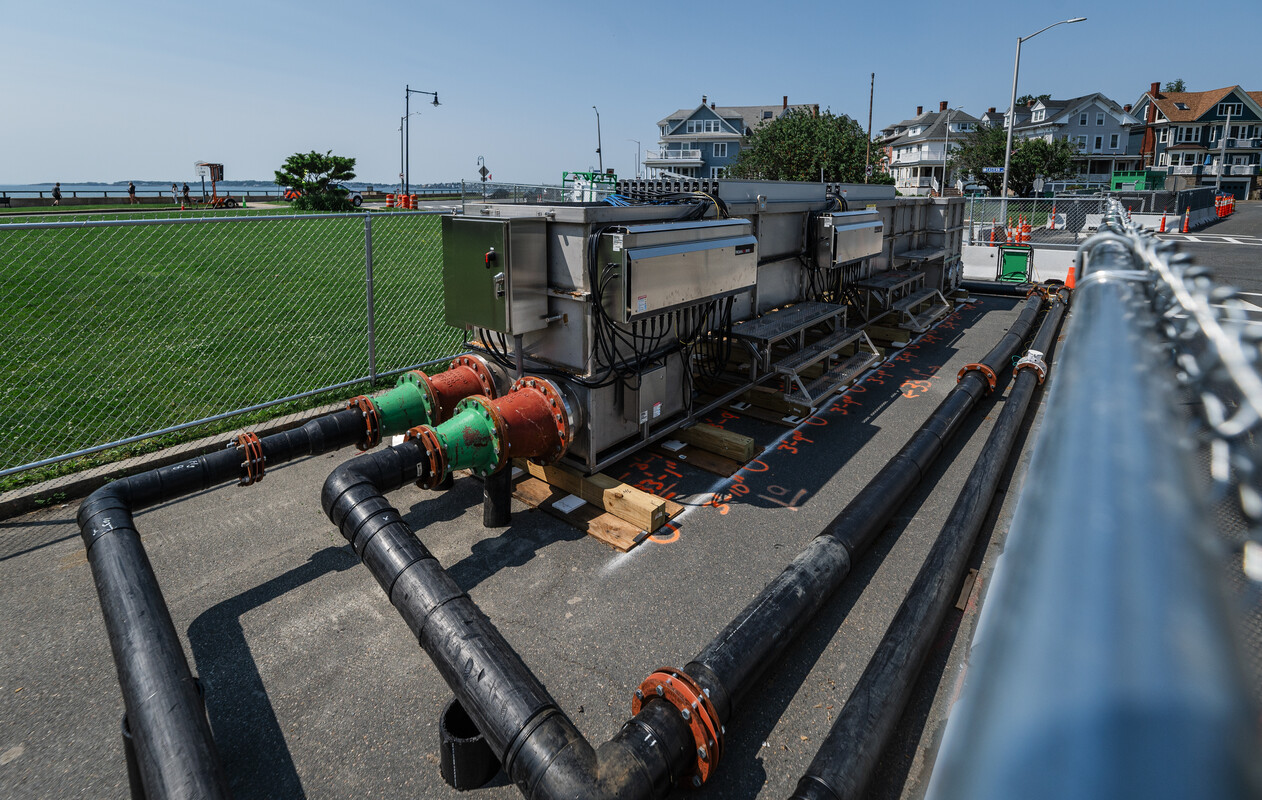
The purpose of the pilot program was to evaluate the effectiveness of UV disinfection on bacteria-contaminated stormwater which currently discharges onto King’s Beach from Lynn and Swampscott through two parallel drainage culverts where the communities meet at Eastern Avenue, Lynn Shore Drive and Humphrey Street. UV is a proven treatment technology used primarily at wastewater treatment plants to inactivate bacteria.
“For the first time, our family—and countless others—could safely swim at King’s Beach. This success is a testament to the effective UV treatment, which was secured through the collaboration and hard work of local, state, and federal partners, advocacy organizations, and community groups,” said Senator Brendan Crighton. “As we finalize the report and program results, our continued partnership will allow us to make informed decisions about King’s Beach treatment options, ensuring the beach can be enjoyed for summers to come.”
The UV pilot was designed to operate continuously during dry and wet weather (with the exception of large rainfall events) and treat flows up to approximately five million gallons per day. The objectives were to determine the effectiveness of UV disinfection at reducing bacteria in stormwater discharging to King’s Beach, gain experience in operating a UV disinfection system, and provide greater access to King’s Beach for the public.
“Four years ago, most of my calls were complaints about King’s Beach,” said Lynn Ward 3 City Councilor Coco Alinsug. “Now, most of the calls are very positive, with happy residents who are glad that we’re doing something for King’s Beach. I am delighted to learn about this report.”
In the 59 days the study was conducted, there were 6 days it was fully offline and 14 additional days when the system was partially offline, due to weather conditions, maintenance and operational issues. Of the 53 full and partial operational days, there were 41 with dry weather and 12 with wet weather. Daily bacteria testing was conducted at 5 sampling locations.
Turbidity is a measure of the clarity of the water, while UV Transmittance (UVT) is a measure of the ability of light to penetrate the water to inactivate the target bacteria. Low turbidity and high UVT are ideal conditions for UV treatment. According to the report, typical UV treatment
systems at wastewater treatment plants are designed for 55-65 percent UVT. The average UVT of the combined Lynn and Swampscott flow was approximately 87.5 percent, a very favorable UVT that could result in less UV intensity needed to meet the same treatment levels as a flow with lower UVT.
The report also indicated that the extent of tidal impacts was greater than expected and initially caused the pumps to be clogged with seaweed. Metal screens were subsequently installed to protect the UV equipment from the seaweed. Regular maintenance was also conducted to remove seaweed from the pumps and the UV system.
“However, despite the operational and maintenance challenges, UV appeared to maintain its effectiveness in the presence of tidal impacts,” the report reads.
“King’s Beach is a treasure for Swampscott and Lynn, and it’s encouraging to see data showing a potential solution for keeping it open and safe,” said Rep. Jenny Armini. “The UV pilot is a model of collaboration between communities when it comes to tackling problems that defy borders.”
The report concludes that UV treatment can increase the number of days King’s Beach is open and safe for residents, even though there are other factors beyond the discharges from the outfalls. It is now up to Lynn and Swampscott to obtain additional information and determine the feasibility of moving forward with a permanent UV facility.
If you have a news story that you would like to share, please contact us via email or call 781-780-9460.

The American Dream: Lt. Governor Kim Driscoll | September 5, 2026
Topic: A review of the first Healey-Driscoll administration & preview of the second
Los Tiempos: Lizardo De La Cruz | September 4, 2026
Tema: Solo La Mano de Dios Te Puede Formar | Lucas 18:3-4