
All Public Beaches from Nahant to Nantasket Receive a Water Quality Score Above 80% According to Save the Harbor/Save the Bay’s Water Quality Report Card
From Save the Harbor/Save the Bay: For the first time in its testing history, Save the Harbor/Save the Bay has reported that every metropolitan beach from Nahant to Nantasket scored above 80% in its annual Water Quality Report Card. This is a historic achievement that reflects Save the Harbor’s 40 years of persistent advocacy, public investment in water infrastructure, and rigorous testing.
The Water Quality Report Card uses data collected by the Department of Conservation and Recreation (DCR) to assess water quality at public beaches from Nahant to Nantasket, including Lynn, Nahant, Revere, Winthrop, East Boston, South Boston, Dorchester, Quincy, and Hull (see table below). Water samples are tested for the number of colony forming units of enterococci bacteria; this is the standard unit used to determine safe swimming conditions, according to the US Environmental Protection Agency (EPA).
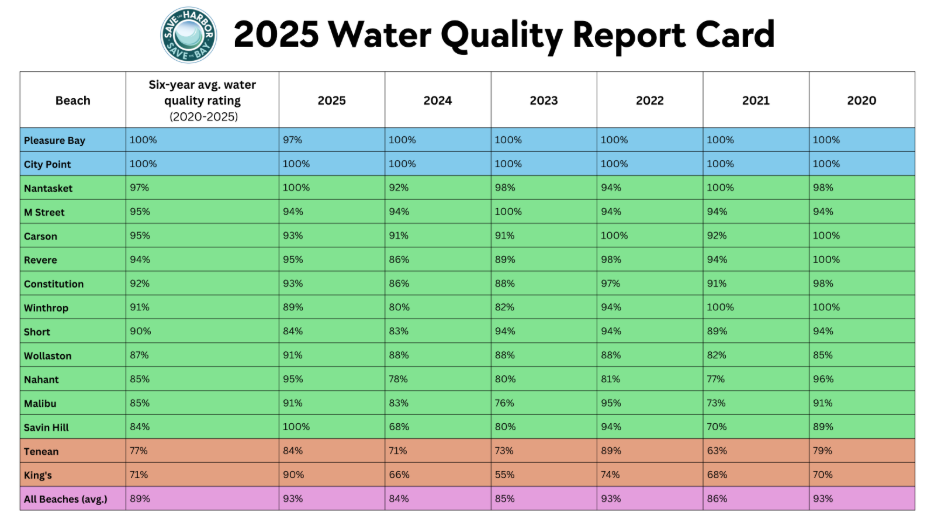
Save the Harbor/Save the Bay releases an annual Water Quality Report Card that uses data collected by the Department of Conservation and Recreation (DCR) to assess water quality at public beaches from Nahant to Nantasket, including Lynn, Nahant, Revere, Winthrop, East Boston, South Boston, Dorchester, Quincy, and Hull.
South Boston’s beaches continue to lead the way. City Point maintained a perfect 100% water quality rating for another consecutive year. M Street Beach and Carson Beach posted a 94% and 95% rating respectively, continuing the region’s tradition of excellence. In addition, Nantasket Beach also scored very well last year, up from 92% in 2024 to 100% in 2025.
“It is gratifying to once again see so many of our spectacular urban beaches consistently testing at safe bacteria levels,” said Save the Harbor/Save the Bay’s Executive Director, Chris Mancini. “The region-wide scores above 80% are a testament to what sustained investment and scientific rigor can achieve. As we mark our 40th anniversary this year, we are as committed as ever to ensuring anyone can confidently get into or out on the water without worrying about bacteria and other pollution.”
Several beaches’ water quality ratings made remarkable comebacks. Nahant Beach rebounded to a 95% rating after four years of hovering around 80%. Meanwhile, Savin Hill Beach, Dorchester jumped to 100% after its dramatic drop to 68% last year.
“We’re proud that Massachusetts continues to have some of the cleanest urban beaches in the country,” said DCR Commissioner Nicole LaChapelle. “These results reflect decades of collaboration and stewardship focused on protecting and improving our public waterfronts, and we’re grateful for our partnership with Save the Harbor/Save the Bay in helping make that possible. It makes a real difference in how people experience our beaches and waterfronts. Clean water is essential, and access to it for recreation is a matter of equity. We remain committed to ensuring these coastal spaces stay resilient, accessible, and welcoming for generations to come.”
Meanwhile, Kings Beach in Lynn had the largest jump in its rating, receiving a 90% water quality rating. This is a significant jump over the six-year average of 69% and 2023’s record low of 55%. The pilot UV treatment program is one factor that contributed to the beach’s water quality improvement. Other factors include the dry summer weather and the improvement to the sewage pipes over the years.
“The continued strong performance of our metropolitan beaches is a testament to 40 years of investment in water infrastructure and the tireless commitment of our partners at DCR and Save the Harbor,” said Senator Brendan Crighton, Co-Chair of the Metropolitan Beaches Commission (MBC). “As climate pressures intensify, we must remain vigilant and continue investing in the systems that protect public health and access to clean water for all.”
Currently the beaches use a posting and flagging system to alert the public to high bacteria levels. Unfortunately, the best technology available takes 24 hours to return results, meaning by the time the posting goes up, the information is already out of date. Save the Harbor recommends people get familiar with their beach’s individual characteristics by using the Department of Public Health’s interactive beach water quality dashboard and to not swim 24 hours after a heavy rain fall event (0.3inches/hr).
Save the Harbor/Save the Bay thanks Dr. Judy Pederson, former Chair of their Beaches Science Advisory Committee, Bruce Berman, former Director of Strategy & Communications at Save the Harbor/Save the Bay, and Kelly Coughlin of Cornell University for their guidance in developing the methodology used in this report.
Additionally, Save the Harbor commends Senate President Karen Spilka and House Speaker Ron Mariano, Metropolitan Beaches Commission Co-Chairs Senator Brendan Crighton of Lynn and Rep. Adrian Madaro of East Boston, and each of the legislative and community members of the Commission for their commitment to clean water and the region’s public beaches from Nahant to Nantasket.
Finally, Save the Harbor also thanks the Healey-Driscoll Administration, the Massachusetts Water Resources Authority, The Massachusetts Executive Office of Energy and Environmental Affairs, the Massachusetts Department of Conservation & Recreation, the Massachusetts Department of Environmental Protection, and the Massachusetts Department of Public Health.
This work is supported by Barr Foundation, Bay State Cruise Company, Blue Cross Blue Shield of Massachusetts, BXP (Boston Properties), The Coca-Cola Company, Department of Conservation and Recreation, JetBlue, Liberty Mutual Insurance, Massachusetts Bay Lines, Massachusetts Department of Environmental Protection, National Grid, and New England Revolution, the Richard M. Saltonstall Charitable Foundation, along with over 100 additional corporate, foundation and individual donors.
About Save the Harbor/Save the Bay
Save the Harbor/Save the Bay is the region’s leading voice for clean water and continued public investment in Boston Harbor, the region’s public beaches, and the Boston Harbor Islands. Since 1986, our mission has been to restore and protect Boston Harbor, Massachusetts Bay, and the marine environment, and share them with the public for everyone to enjoy.
Save the Harbor is committed to making Boston Harbor, the Islands, our beaches, and our programs inclusive, equitable, diverse, and accessible to everyone and anyone. We provide free programs, events and create opportunities for people to experience Boston Harbor and our spectacular urban natural resources first-hand, with an emphasis on breaking down barriers of race, language, income and ability.
About the Metropolitan Beaches Commission
The Metropolitan Beaches Commission (MBC) was created in 2006 by the Massachusetts Legislature to take an in-depth look at the Boston metropolitan region’s 15 public beaches in Nahant, Lynn, Revere, Winthrop, East Boston, South Boston, Dorchester, Quincy, and Hull which are managed by the Department of Conservation and Recreation (DCR).
The MBC is comprised of elected officials and community leaders from Boston and the metropolitan region’s waterfront neighborhoods and beachfront communities. Its work is facilitated by Save the Harbor/Save the Bay, which has served as lead consultant to the Commission since its inception.
The MBC is charged with making findings and recommendations to the Legislature and DCR on ways to improve the metropolitan region’s public beaches. Senator Brendan Crighton of Lynn and Representative Adrian Madaro of East Boston are the MBC’s Co-Chairs.
If you have a news story that you would like to share, please contact us via email or call 781-780-9460.

Truth, Justice & The American Way! | October 15, 2026
Truth, Justice, & The American Way! is a talk show hosted by Paul Crowley with Joe Spina, with a...
Sin Temas Podcast: Coco Alinsug | October 15, 2026
Sin Temas, Un Programa Donde Usted Pone Los Temas. The views and opinions on this program and other member...